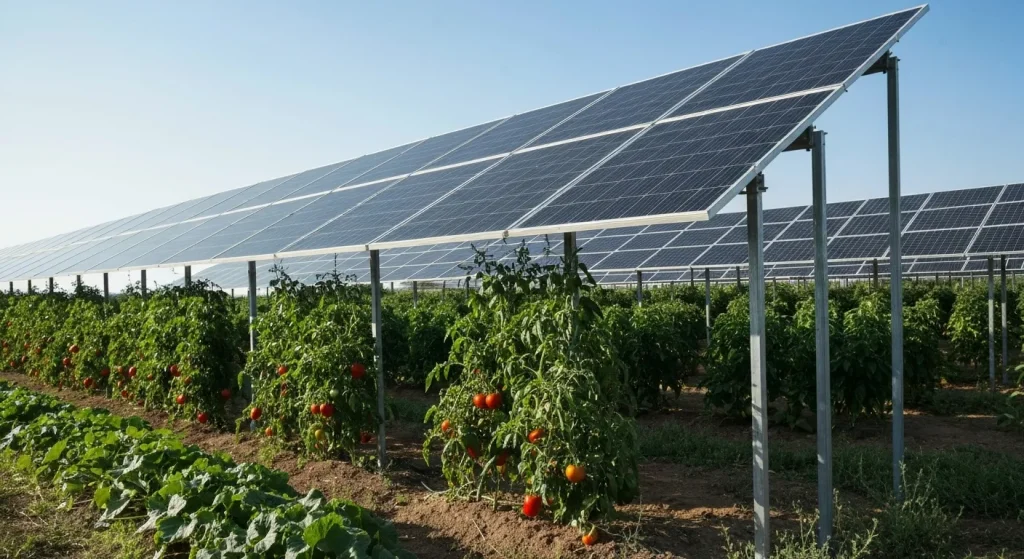
Bun venit la Jack’s Solar Garden, o fermă din Colorado care este pionieră în agrivoltaică—un sistem care implică cultivarea plantelor alimentare sub panouri solare.
Pe parcursul ultimului an, această fermă de familie de 9,7 hectare din Boulder County a produs energie curată prin intermediul a 3.276 de panouri solare care generează suficientă electricitate pentru a alimenta aproximativ 300 de case, în timp ce cultivă culturi durabile. De asemenea, găzduiește mai multe proiecte de cercetare privind sinergiile care se stabilesc atunci când energia solară și producția de alimente sunt combinate, făcând-o cea mai mare facilitate de cercetare agrivoltaică activă comercial din SUA.
Logica din spatele agrivoltaicii este că cultivarea plantelor pe unele dintre cele aproximativ 809.000 de hectare de teren din SUA care ar putea fi acoperite de panouri solare până în 2030 ar putea aduce numeroase beneficii pentru sănătatea solului, gestionarea apei și populația locală de insecte.
Prin intermediul unui proiect numit InSPIRE, Laboratorul Național pentru Energie Regenerabilă al Departamentului de Energie (NERL) studiază agrivoltaica în aproximativ 20 de locații din SUA.
Sistemele agrivoltaice sunt simple. Panourile sunt instalate la un nivel mai înalt pentru a permite plantelor să crească dedesubt. Stratul superior al solului rămâne netulburat și este plantată o diversitate de culturi.
Agrivoltaica nu este potrivită pentru fermierii mari care au nevoie de utilaje grele pentru a-și cultiva terenul, dar pentru micii cultivatori, beneficiile sunt extinse. Plantele native atrag polenizatorii, cum ar fi albinele, care pot ajuta la îmbunătățirea randamentului culturilor, în timp ce rădăcinile lor ajută la menținerea umidității solului în perioadele de secetă și previn scurgerea apei care ar putea contribui la inundațiile induse de schimbările climatice.
Aceste beneficii ar putea ajuta la descurajarea opoziției față de proiectele solare în rândul persoanelor care consideră panourile solare „urâte”.
Dar există și stimulente financiare, deoarece panourile solare reprezintă o sursă suplimentară de venit pentru fermieri, iar vegetația poate stimula generarea de energie electrică.
„Temperaturile mai ridicate pot reduce eficiența cu care celulele fotovoltaice convertesc lumina soarelui în electricitate. Umbrirea solului și evaporarea crescută oferite de un strat sănătos de vegetație dedesubt pot de fapt răci panourile solare, crescând producția lor de energie”, spune NERL.
PlanetaNoastra l-a intervievat recent pe Byron Kominek, proprietarul și managerul Jack’s Solar Garden, pentru a afla mai multe despre agrivoltaică:
PlanetaNoastra: I understand you have been operational for a year, how are things going?
Byron Kominek: On Nov. 1 we will have been putting in power for a year. It was a stressful year. Trying to get the land prepared, getting all our researchers set up, trying to figure out how everything was going to work for the season. We also partnered with a nonprofit called Sprout City Farms and they have been growing food here since the end of June on about an acre of land underneath the panels. It’s nice to see what you’ve been working on for years starting to happen. This is just the first year. We’re going to get better at it next year and the following year. I look forward to the coming years.
How did the farming go?
They’ve grown close to 6,000 pounds of food. They’ve been growing lots of tomatoes and peppers. They harvested a lot of beets today, different types of squashes, pumpkins, radishes… Earlier on we had different types of lettuces like arugula, plenty of kale, lots of different types of beans and carrots, and some types of flowers.
Do they use sustainable methods?
They don’t use chemical sprays. We did tilling this year because we had to create the crop beds but they do not intend to till in future years. It’ll turn into a no-till organic farm. It won’t be certified organic because doing that costs a lot so we’ll just do it without getting the certification. Also, the majority of the production has been going to places where people in need of food can go, they have been dropping thousands of pounds of food there.
Who do you sell power to?
We sell electricity to residents and commercial entities, as well as the government. Residents and the government purchase upfront for either 5, 10, or 20 years to help us with the construction of the solar array. We also have commercial entities that purchase power from us on a monthly basis. We have two cannabis companies [In The Flow and Terrapin] a bank, [Premier Members Credit Union] and a company that produces mushroom root-based meat [Meati].
What are the benefits of combining solar panels with agriculture?
Land can have lots of different uses, it doesn’t have to be one thing. We’re still learning about the ways in which we can work the land underneath the panels to grow food better, but what we’ve found is that panels provide more shade, and more shade means less evaporation from the soil. The idea is that there’s more moisture retained in the soils than if there were no panels, and that means you don’t have to irrigate as much. And if you’re in an arid or semi-arid climate, that’s important.
Can you tell me more about the research that is going on at the farm?
NERL is looking at wildflowers, pollinator flowers, underneath the solar panels, and they’ll study pasture grass underneath some panels next season. The University of Arizona is looking at the different types of micro-climates, trying to do comparisons between crop growth underneath panels at different heights, as well as outside the solar array. Colorado State University is looking at how water moves underneath the panels by measuring soil moisture content over the course of the season to better understand where moisture sits longer, and at ecosystem services such as carbon sequestration.
You have also created a non-profit to promote agrivoltaics, the Colorado Agrivoltaics Learning Center, can you tell me more?
__PLACEHOLDER_ID_14__I think it’s important that society knows we can do more with our land. Solar developers want to put up a ton of solar panels to help meet our clean energy goals. We shouldn’t ignore that the soil beneath can still be productive. We just have to redesign the solar array somewhat. Namely, you have to put the panels up higher. If the panels are touching the ground, it’s going to be hard to grow anything underneath and even harder to get somebody underneath to work the land. Basically the higher up you put the panels, the easier it is to maneuver underneath the solar array to get stuff done.
Over the next few years, the U.S. will see the largest peaceful land transition that the world has ever seen as older generations pass on land management to the next generation. And the question is ‘are these lands going to be producing enough revenue or is climate change going to be too harsh for these lands to grow food?’ I think of this as a government policy. It’s imperative to figure out if we’re going to transition large swaths of agricultural land to just solar arrays or if we’re going to figure out how to do the two together.__END_PLACEHOLDER__


